
MIMOZA WAYS
Introduction

Mimoza Ways is a theatrical production that blends historical and educational value, depicting 100 years of struggles and achievements of women in Japan in their pursuit of gender equality. From the founding of "SEITO" Bluestocking Japan’s first women’s magazine written by and for women in 1911 - to the women’s suffrage movement, the Women’s Liberation movement of the 1970s, and nowadays. The play highlights the challenges women have faced and their paths to overcoming them. The Comité exécutif de la Passerelle franco-japonaise pour les droits de femmes Mimoza, together with playwright, director, and actress Trinidad, spent four years conducting interviews with 70 women and working under the supervision of experts to create this new production.
Mimoza Committee for Women's Rights
Produce: Namino HORII-RIVOAL
Script and Theatrical direction: Trinidad GARCIA
Premiere: Kyoto, 2022
Re-run: Tokyo & Fukuoka, 2023
Film Screenings, Workshops, and Lectures events have held across Japan
This project was selected for the 2020 and 2023 Akamatsu Ryoko Gender Equality Fund.
Act 1: Present Day
At Charles de Gaulle Airport in Paris, many people are waiting for disrupted return flights to Japan. Among them are Keiko, Yumi, and Mari, who are waiting for their flight back to Japan.

The setting is 2020. The coronavirus has swept across the world, and a lockdown has been declared in France.
In the midst of the pandemic and the forced return to their home country, the three women begin to share their individual circumstances. Their past experiences with love, abortion, and their perspectives on sexual and reproductive health rights (SRHR) in Japan, which have made little progress, are discussed.
From the play Mimoza Ways:
"In Japan, you know, contraception, especially options for women, is not well-known! It seems like condoms are the only choice! The pill is said to be harmful to the body, and it’s expensive.
The 'morning-after pill,' as it’s called in French, requires a prescription from the hospital.
What about abortion pills? They cost the same as an abortion procedure—100,000 yen!
What about abortion procedures? You need the partner’s (spouse’s) consent. If a woman abandons a newborn, she can be arrested and treated as a criminal.
What about the person who got her pregnant? They have no responsibility!!"

She is able to travel through time. She is the collective of all the women who have ever lived. They watch over us.
Ryoko directly knows the great-grandmothers (the grandmothers of their grandmothers) of Yumi, Keiko, and Mari, who live in the present day. She invites them to the era of 100 years ago.
Ryoko
Reference Materials
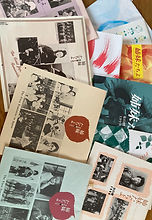
These materials include references used in the creation of "Mimoza Ways," as well as new information acquired after the production. These materials will be updated in the future to deepen the understanding of the work.


Act 2: 1910's
From left to right, Yumiko, Kiyo, and Machiko. In 1912, the era changed from the Meiji period to the Taisho period.

The setting is 1910, at a kimono tailoring shop run by Kiyo's aunt.
From the play Mimoza Ways:
"In 1898, during the 31st year of the Meiji era, the Meiji Civil Code stated that 'women are legally incapable,' meaning they were considered to have no legal capacity.
In that era, the rights women had were, (irony)
-
The right to silently listen
-
The right to marry the man chosen by their parents
-
The right to bear children
-
The right to raise children
-
The right to take care of the entire family
-
And the right to obediently comply
As daughters, they followed their fathers; as wives, they followed their husbands; and in their old age, they followed their sons—a 'right to suffer under the three obediences.'
In such a time, in 1913, the 2nd year of the Taisho era, the first female university students were born at Imperial University: Chika Kuroda, 29 years old, Raku Makita, 25 years old, and Ume Tange, 40 years old...
In a society where it was the norm for women to be 'good wives and wise mothers' supporting others from the shadows, women began to challenge this idea. One of them was Raichō Hiratsuka. At 25 years old, Raichō, on the recommendation of her mentor, founded SEITO (Blue Stockings), a literary magazine for women, in 1911..."


Act 3: 1920's
From left to right, Machiko, Yumiko's daughter Yasuko, and Kiyo.

On the screen, the shadows of the cast and footage from that era alternate. Between the images, excerpts from letters exchanged by the characters of 1910 and the next generation of women are shown, providing insight into their subsequent stories and historical events. Through the correspondence between Machiko and Kiyo, we meet Yumiko's daughter, Yasuko.



Act 4: 1970's
From left to right, Ryoko, Kimiko, Mariko, and Yuka.

In the 1970s, revolutions led by young people broke out around the world. They began to question the education system that was trapped in the traditions of the older generation and dreamed of a new world. The Vietnam War accelerated the momentum of revolution in both the United States and Japan. Amidst this revolution, another revolution led by women, the Women's Liberation Movement, emerged. In Mimoza Ways, we encounter the shining women of the 1970s, including one of the symbols of the Women's Liberation Movement, Mitsu Tanaka, who wrote the manifesto "Liberation from the Toilet." Also featured is Misako Enoki, who fought wearing a pink helmet, demanding the legalization of the birth control pill as part of the "Women's Liberation Union" opposing the abortion ban. Inspired by American female writers like Betty Friedan and Kate Millett, Emi Funamoto, in 1973, with five other women, published the magazine Onna·Eros (Women·Eros) with an initial run of 10,000 copies, aiming to create a space for women to express their sexuality and lives.
The topic of choice of separate surnames in marriage is also discussed. Kimiko: "Look at my fiancé! He said that when we get married, he’ll take my surname!


Act 5: 1990's
From left to right, Yae, Kikue, Mai.

Discrimination Against Women (CEDAW), the following changes were made:
-
Domestic laws were amended so that nationality could be inherited from both parents, not just the father.
-
The curriculum was revised, making home economics a mandatory subject for both girls and boys.
-
The Equal Employment Opportunity Law was enacted, ensuring that men and women are treated equally in the workplace.
Impressive, right? Of course, it’s all on paper. The reality is much more complicated.
In the 1990s, women continued their revolution. One might call it the “Quiet Revolution” or the "Visa Card Revolution." During this period, the connections between the children of three families were severed. However, by chance, they all found themselves at a resort hotel poolside in Hawaii, and it quickly became clear that their mothers had been friends...


Act 6 : Back to the Present Day

Have the courage to shed light on the important things buried within each of you.
As former Minister of Education, Ryoko Akamatsu once said, 'Let’s give birth to them small, and raise them big!'
Informations sur l’organisation
Comité exécutif de la Passerelle franco-japonaise pour les droits de femmes Mimoza
Ce comité organise divers événements et projets fondés sur la transmission et le développement de l'histoire des femmes, tels que des représentations théâtrales, lectures, projections et conférences, dans le but de promouvoir une société égalitaire en matière de genre.
Appel aux dons
Nous préparons l’organisation d’une tournée des 47 préfectures du Japon qui sera lancée par une représentation à Paris en 2027.
Afin de pouvoir réaliser ce projet, nous sollicitons votre soutien et votre coopération.
Contact :
Site Mimoza Ways : https://www.woman-engeki.com/
L’équipe de Mimoza Ways
Trinidad GARCIA Scénario et mise en scène
Organisation: Comité exécutif de la Passerelle franco-japonaise pour les droits de femmes Mimoza
HORII-RIVOAL Namino Organisation, production et traduction
Rebecca JENNISON
YANBE Yuhei
Co-production - MUZ ART PRODUCE
Lignée de Mari │ CARDONNEL Lou
Lignée de Keiko │ NAKATANI Kazuyo
Lignée de Yumi │ KUROKI Yoko
Ryoko, Assistante-metteuse en scène (Kyoto) │ YANAGIDA Alice
Ryoko (Kyoto) │ YAMAGAMI You
Interprète et assistante-metteuse en scène (Tokyo) │ TAKENAKA Kyoko
Régisseuse de plateau │ KITAKATA Kodachi
Éclairagiste │ KIUCHI Hitomi
Ingénieure du son │ MICHINO Yukina
Costumière │ KAWAGUCHI Tomomi
Vidéo │ FUKUOKA Sou
Coordinateur de production │ WATANABE Hiroshi
Assistante-metteuse en scène (Kyoto) │ Madorène
Collaboratrice production │OHASHI Yuuri, WAKEBAYASHI Kanako (Kyoto)
Assistante production │ NAGASAWA Moe (Tokyo)
Assistante production │ KUJIRA Emma (Tokyo)
Accueil │TAKAHASHI Tomomi (Q's Link) (Fukuoka)
Collaboration traduction │ Aline KOZA, CARDONNEL Lou
Collaboration traduction du texte de scène │ YAMAGAMI You, Distribution Mimoza
Traduction (Anglais) │ Ruth WIN, Rebecca JENNISON, Jennifer TEETER, France BARTH
Collaboration scénario │ KUROSAWA Hisako
Supervision éditoriale │ SHINDO Kumiko, ISHIDA Kuniko , MIKI Soko, YANBE Yuhei
Conception graphique de la promotion│ m9design.inc
Collaboration éditoriale │ Reiko
[Représentation]
⚪︎ Kyoto - THEATRE E9 KYOTO, février 2022
- Avec l’aide du Fonds pour l'égalité des genres AKAMATSU Ryoko et de la Fondation Franco-Japonaise Sasakawa, et le soutien de DMG MORI Co., Ltd.
- En partenariat avec THEATRE E9 KYOTO (Art Seed Kyoto)
⚪︎Tokyo - Tokyo, Fussa Civic Hall, février 2023
- Avec l’aide de la Fondation Franco-Japonaise Sasakawa
⚪︎Fukuoka - Clover Hall, février 2023
- En collaboration avec le Centre pour l'égalité des genres de la préfecture de Fukuoka (Asubaru)
Parrainage:
-
Ambassade de France / Institut français du Japon
-
Bureau de Kyoto du journal Asahi Shimbun
-
Bureau de Kyoto du journal Mainichi Shimbun
-
Parité Café Kyoto
-
Women's Action Network
-
Délégation du Japon de la Renaissance Française
-
Organisation pour la promotion de l'égalité des genres
-
Festival du film pour les femmes seniors (Tokyo)
-
Women's Action Network (WAN) (Tokyo)
[Lecture spectacle]
-
Miyagi : Centre pour la promotion de la DEI (Diversité, Équité et Inclusion) de l'Université du Tohoku, décembre 2023
-
Tokyo : Plan International Japan, Hall de Toshima, Tokyo, juin 2022
-
Osaka : Forum pour l'égalité des genres de Takatsuki, février 2023
-
Kyoto : Université Seika, Séminaire de la Professeure Jennifer Louise TEETER, décembre 2022
-
En ligne : Centre national d'éducation des femmes du Japon, « Forum pour la promotion de l'égalité des genres », août 2020
-
En ligne : Centre national pour l'éducation des femmes du Japon, « Forum pour la promotion de l'égalité des genres », décembre 2021
[Projection]
-
Genève, Suisse - Institut de hautes études internationales et du développement, octobre 2024
-
Tokyo - Centre pour l’égalité des genres de Bunkyo, juin 2024
-
Tokyo - Centre de recherche sur le genre de l'Université Aoyama Gakuin, avril 2024
-
Tokyo - Événement commémoratif de la Campagne Parité pour l’obtention du droit de vote des femmes, avril 2024
-
Yamanashi - Centre pour la promotion de l'égalité des genres (Pure Sogo), mars 2024
-
Tokyo - Centre pour l'égalité des genres de Kiyose (ILEC), mars 2024
-
Tokyo - Université Sophia, Projection organisée par le Professeur Simon SERVERIN, décembre 2023
-
Tochigi - Association pour la promotion de l'égalité des genres (Événement de soutien au G7 Tochigi), juin 2023
-
Tokyo - Action pour la réalisation de la convention sur l'élimination de toutes les formes de discrimination à l'égard des femmes @ Tokyo Women's Plaza, novembre 2023
-
Kyoto - Université Doshisha, Séminaire de la Professeure KANNO Yuka, février 2022