
【 London Event Report】『MIMOZA WAYS』Full screening and Discussion 17.April 2026 in London

Afficher en français
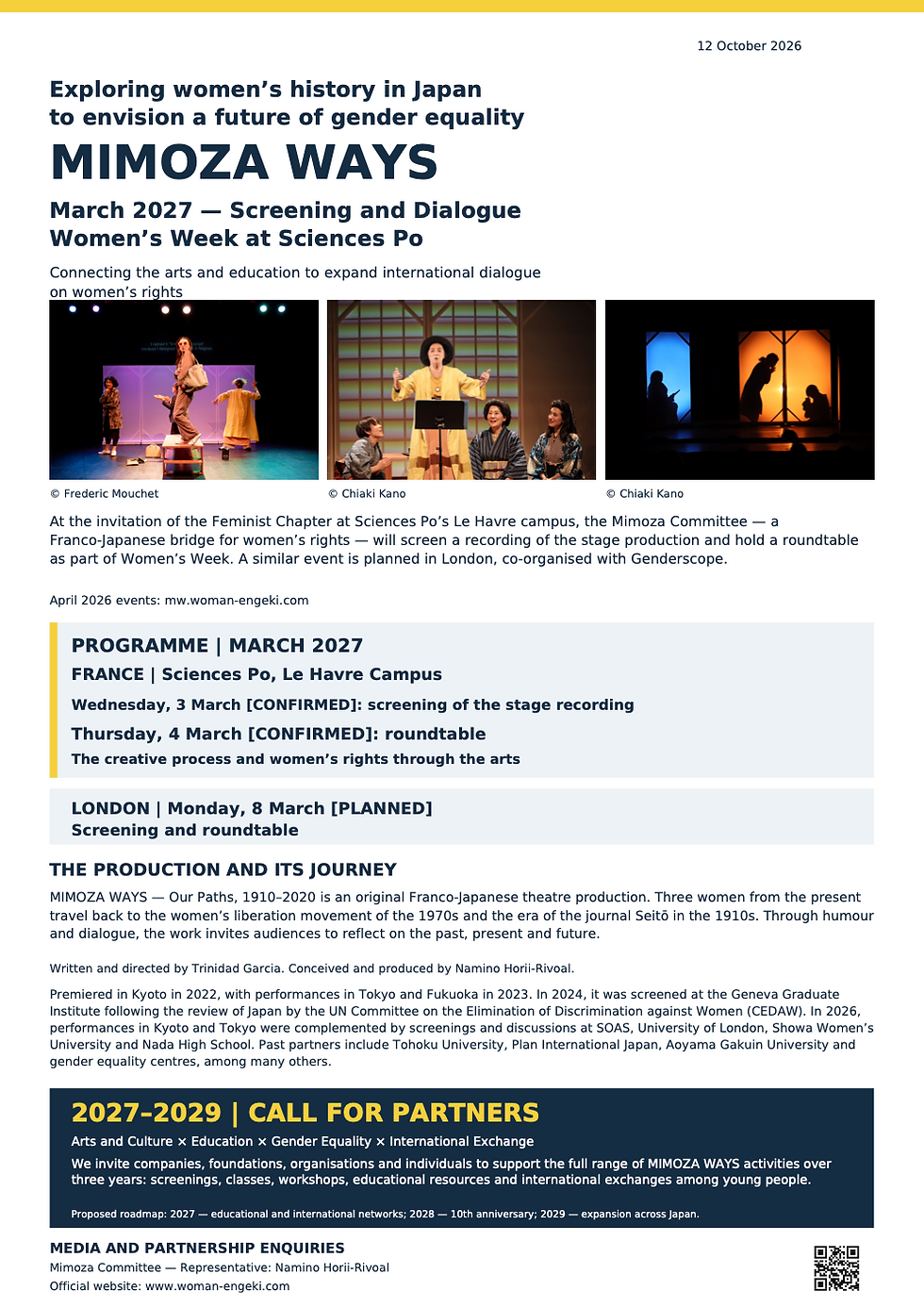
On Friday, 17 April 2026, a screening of Mimoza Ways was held, followed by a talk with producer Namino Horio-Rivoal and playwright and director Trinidad García, moderated by Sinem Hun of Gender Scope. The session explored how Mimoza Ways was created and the process and circumstances that led to its development.
This report reviews the key points raised by the speakers on the day and provides a structured record of the flow of discussion.

🔳Panelists
Namino Horii-Rivoal:Producer, translator of Mimoza Ways
Trinidad García: Play writer, Stage Director of Mimoza Ways
🔳Moderator
Sinem Hun: President of Gender Scope
Sinem
Thank you very much for being here with us today. You have given your time, your attention, and your energy to this work and to all of us.
The Mimoza Ways production we have just watched is the first theatrical work created in Japan to tell the story of women across 100 years of history. It is not simply a play. It is also a living record of women's struggle, resistance, courage, and change.
Today, we would like to explore this work through three perspectives: the past, the present, and the future. I would like to begin with Namino. How did you meet, and what brought the two of you together to create this work? What inspired you to tell this story?
Namino
Hello, everyone. My name is Namino Rivoal Horii. I am very happy that you have watched the work today.
I came here alone today, but this play was created through my meeting with Trinidad Garcia. In Japan, the Mimoza organising committee includes Rebecca Jenison, Yanmei Yuhei, Sae Cardonnel, who worked as co-producer, and Aline Koza, who worked as translator. The performers include Cardinal Liu, Mika Sugawa, Yoko Kuroki, and Katsuyo Nakatani. The staff include Kodachi Kitakata, who was the stage director, Hitomi Kinouchi, who worked on lighting, Tomomi Kawaguchi, who worked on costume, and Sou Fukuoka, who worked on the video. We made it together.
To return to the beginning: in 2017, I saw one of Trinidad's plays in Paris. The flyer asked, “Can feminism be laughed at?” The title of the play was Et pendant ce temps Simone Veille!, and the script is also being sold today. I happened to go and see it in Paris, and I found it very funny and very interesting.
It was not only me who was enjoying it. There were men and women in the audience, and the men were also laughing and enjoying themselves. I thought that was wonderful.
I work as a translator, so I approached Trinidad and asked whether I could translate the work. That was how it began.
At that time, in Japan, feminism was often seen as something frightening, or as something that people should not talk about too much. But I wanted to introduce a work in which men and women could think together while laughing.
At first, I simply wanted to translate the French play. However, as Trinidad and I continued talking, the idea changed. We began to ask whether it might be possible not simply to translate a French work into Japanese, but to create a new story about Japanese women, for Japanese women.
Trinidad
When Namino saw my work in Paris, I was on stage. At the end of the performance, I was selling the script and Namino came over to me.
Namino told me that she worked with women's rights organisations and that she wanted to talk about my work in Japan. I wrote a dedication in the script saying, “Let us build a bridge between France and Japan.” At the time, I did not know that this bridge would one day really exist.
That was in August 2017. Then, in December 2017, I received a message from Namino on Messenger. She told me that she would like to translate my work, and we continued talking. Through those discussions, a rather extraordinary idea emerged: why not write the story with and for Japanese women?
When I first had this idea, all I knew about Japan was sushi made by Chinese people in restaurants in Paris. From that point, over approximately four years, I learned about and shared Japanese culture. That was the beginning of an extraordinary story.
For the first year and a half, we talked a great deal. Then, in 2019, Namino invited me to Japan for the first time. We prepared a questionnaire and met approximately 30 women of different ages and backgrounds.
The central questions were: “Do you know the story of your mother or your grandmother? Do you know the history of your family line?”
From the approximately 30 women we met during that first trip, I began to imagine the characters and to build their different family lines and stories.
Then COVID arrived. At the beginning of 2020, just before COVID spread in France, I was invited back to Japan for a performance at the Institut français in Kyoto. We met more women there and continued the interviews. Then COVID happened, and, like everyone else, we felt as if our wings had been clipped.
But Namino's perseverance and determination kept the project moving. Namino told me, “We will continue. We will continue.” Mimoza Ways became Mimoza Zoom.
The first performances took place in February 2022. Japan was closed, and I could not travel there. Namino still wanted me to direct the production, so every morning at 5:30, I sat in front of a screen and directed the rehearsals online.
I knew how much Namino had invested in making the performance happen, so I was anxious. At the same time, almost every day there was a suspicion that one of the performers had COVID. It was a very difficult situation. As a French woman, it was also difficult not to say, “Do not follow these rules.”
Nevertheless, we did it. In 2023, I returned to Japan and we performed in Tokyo and Fukuoka. I was finally able to meet in person the women I had previously known only through a screen. It was as if we had known each other forever, and the reunion was truly wonderful.
The Research and Creative Process
Sinem
I would now like to ask about the research journey. As you wrote and co-created the work, what kind of research did you undertake, and what kind of emotional and intellectual journey did you experience?
Trinidad
I think this project is one of the most wonderful gifts that life has given me. I never imagined that life would take me 9,000 kilometres away, allow me to experience this adventure with so many women, and introduce me to this culture.
There are differences between Japan and France. At the same time, there are also things that connect us. The emotions were there, and that was proof of what we share.
One of the extraordinary things I discovered in Japan was the toilets. That is partly a joke, but what was truly important was meeting, in person, the women we interviewed.
There were also people who supervised the writing and checked whether what we were saying was accurate and whether there were any mistakes. Then there were the women we discovered through history.
Unless I am mistaken, Namino discovered many of these women together with me. One of the figures who had a particularly strong impact on me was Fusae Ichikawa, whom I learned about when we visited the Fusae Ichikawa Memorial Association.
But the woman who moved me most deeply was Raicho Hiratsuka. If I believed in reincarnation, I would say that I was the reincarnation of Raicho Hiratsuka.
When I look at her, I feel a great deal of emotion. Despite the distance of 9,000 kilometres and a difference of one century, we share a similar vision of women. She uses the word “genius,” while I use the word “power,” but we are both trying to look for the power that each woman carries inside herself and does not always see.
The distance between France and Japan also allowed me to see things that had been directly in front of me in France.
The Japanese women I met were very strong women. They had travelled, studied, and achieved a great deal. And yet, sometimes they did not see the power they had within themselves. Education and achievement had not necessarily been encouraged for their own sake, but in order to find a husband, for example.
What struck me very strongly was the idea that the men who dominate us are often men who are afraid. When women recognise their own power, they no longer have to ask men for permission to have a place. They can take that place themselves.
Like Raicho Hiratsuka, I believe that writing and words can change the way people think.
Namino
I would like to explain how I created this project.
I had the idea for the project in 2017, but at first I was very worried about how to make it happen. At the time, I was working as a university assistant. I talked with professors and students and asked them what I should do.
The most important thing I was thinking about was that I must not communicate only my own point of view. I must not convey inaccurate historical information. This is a history seen from women's perspectives, but I needed to find a way to present it that was not limited to my own perspective.
The organising committee includes people who have lived in Japan for 40 or 50 years. We created a community with people who had lived in Japan for a long time, and they spoke directly about Japan in English, Spanish, French, and other languages, including both the positive and negative aspects.
In the next stage, we travelled to different regions. Through interpreters and through friends of friends, we spoke directly with people in communities that were not necessarily connected internationally or connected to people overseas.
The organising committee also researched a great deal of material. We looked at books, films, and online resources. After COVID began, we conducted interviews online as well.
I think the creative process had two stages: first, creating the script, and then creating the stage production once the script existed. During the pandemic, the National Women's Education Center began holding online events every year. In preparation for those events, we spent a year working on each of the periods 2020, 1910, and 1970.
Being selected for the Ryoko Akamatsu Gender Equality Fund was also very important. When everyone was having an extremely difficult time because of COVID, being selected gave us the motivation to continue.
We researched and conducted interviews. Trinidad wrote the script, and the organising committee translated it. We read it again, discussed what it meant in the Japanese context, and rewrote it. We continued to update the work through this process.
There was also a festival in Kyoto, where we created the stage production with the young staff I mentioned earlier, with Trinidad, and with people working internationally in Japan.
Trinidad
I wrote the script scene by scene. But in reality, from the beginning, I had the whole story of each character in my mind.
In the first version, the story began in 2020 and moved backwards towards 1910. Then, when we began rehearsing in December, I thought that we really needed to make the reverse chronology clear. We changed it so that it moves from 2020 back to 1910.
The work is constantly evolving. There is still more work to do. On this occasion, changes were decided within ten days, which was very difficult for the performers. Nevertheless, we did it.
Sinem
Why did you decide not to include the 1950s in the play?
Trinidad
It was a question of time. As I explained, we did not have enough time. The characters already had their own stories, and those stories were complete without adding the 1950s.
Changes in Japanese Society and Current Challenges
Sinem
I would like to ask about Japan and about the changes since you began working together there. Compared with when you started the project, how has the situation for women in Japan changed over the past ten years? There have also been global movements and important political developments. How have those changes been felt in Japan, and what challenges still remain today?
Namino
Before we began making the work, people told me that there had not been much change in Japan. However, as we continued creating the work, I came to understand that Japanese feminism had always existed, as you could see in the performance.
The project began in 2017, just before COVID. The pandemic made the problems of Japanese society much more visible.
For example, it made the large number of women working in non-regular employment more visible. It also made visible the difficulty of combining childcare and work, and the fact that when schools closed, it was women who were expected to manage the situation at home.
The #MeToo movement also had a major influence. I was strongly influenced by it myself. I was particularly inspired by the work of journalist and filmmaker Shiori Ito.
The work also refers to the Equal Employment Opportunity Law of 1985 and other laws. There have been improvements, but many challenges remain.
In 2024, I attended a meeting of the UN Committee on the Elimination of Discrimination Against Women, which is also referred to in the play. The issue of married couples having different surnames was discussed there as well. There are still many unresolved issues.
Sinem
Trinidad, you are based in France and work internationally. From your perspective, what are the most important challenges facing women in Europe and around the world today? Do you see common patterns across countries? How do you think about the future and the direction in which the world is moving?
Trinidad
For me, feminism is above all a personal decision.
That is why I created the works in France and Japan in a transgenerational form. Everyone should ask themselves what kind of woman they want to be. In relation to their mother, their grandmother, and the women in their family line, they should ask what they want to inherit, what they want to reject, and what they want to change.
If women ask themselves these questions, perhaps men will also begin to ask themselves the same questions. Before men and women face each other, each person needs to know what kind of human being they want to be.
I think that one of the greatest influences on a woman can be her mother. This does not mean that mothers are bad. It means that when a mother has not been able to make choices for herself and for her own life, it can become very difficult for her daughter to choose her own life afterwards.
We could see this clearly in Japan. When we interviewed women in their thirties, they all said the same thing. We looked at one another and were astonished.
When we asked, “Do you have a better life than your mother?” they all answered, “Yes.” But afterwards, they all added, “I feel guilty.”
On the negative side, what worries me is the rise of religion in relation to women. In France, the influence of religion is growing. For me, religion has never served women. It can reduce women to being either mothers or saints.
When I think about the 1910s, I believe that women's liberation and emancipation are connected to rebellion, to knowing oneself, and to knowing one's desires and one's body. That can frighten men.
Another negative aspect is radical feminism. At least in the form of radical feminism that we know in France, I do not think it always produces good results. It can simply strengthen masculinism on the other side.
What connects people across the world is, unfortunately, violence.
On the positive side, one thing that struck me very strongly in Japan was the importance of fathers in women's lives. Many women in their fifties who built careers in Japan and who live genuinely free, self-chosen lives were encouraged by their fathers.
Messages for the Next Generation and the Future
Sinem
Finally, I would like to ask about your plans for the future. What message would you like to give to young people and young women? How do you see the future of this work, Trinidad?
Trinidad
The positive thing is to know that in every country and in every period of history, there have been women who, despite constraints, chose to live differently.
As we also discussed in Japan, men too want a different place from the one they have been given until now. Some men want to participate fully in family life as fathers.
In France, in this unstable world, men do not necessarily want to go to war and become heroes anymore. There are things changing among both women and men. I think that is very positive. In every country and in every period, women have found different ways to live despite constraints. In Japan too, men are looking for different roles and want to participate in family life as fathers.
I wrote a version of the work centred on men in France. It also deals with transgenerational themes, but while writing it, something became especially clear to me: the damage that war causes to men.
The men's trauma of war and the silence that comes from memories of war are part of what I want to explore. I want us to think across generations not only about women's stories, but also about what men carry and what they are unable to say.
The message I would like to give to the younger generation is: believe in yourself.
Namino
In Japan, women curators and women working in the arts are increasingly active. Exhibitions of women artists and contemporary women artists are being held at places such as the Osaka National Museum of Art and the Hyogo Prefectural Museum of Art. Women's histories are gradually becoming more visible.
And Mimoza Ways is not “His Story”; it is “Her Story.” As Trinidad said earlier, we still do not know enough about Japanese feminism 100 years ago, including the work of Raicho Hiratsuka. It has not been sufficiently passed on to the next generation.
When younger people come to see the work, they sometimes say that they want to know more about Japanese feminism and share it with others.
I was empowered by making this work. I would be happy if everyone who watched it today also felt, even a little, empowered by it. That is why I would like to continue this kind of work in Japan.
When we continue thinking about women's issues in Japan, we eventually reach the issues faced by men as well. Long working hours for men and the high suicide rate among working-age men are also serious problems in Japan. Gender issues are not only women's issues.
Creating a theatre production requires funding. If I can find the funding, I would also like to create the men's version in Japan.
Trinidad
It is important for both women and men to think about what kind of people they want to be and what they want to change.
The fact that there are constraints does not mean that there is only one possible choice. In every period and in every country, women have found other paths despite the constraints placed on them. Knowing this can give strength to the next generation.
Sinem
Thank you very much for joining us today.
Comments